Boiler Upgrade Scheme: £7,500 or £9,000 off a heat pump, explained
If you own a home in England or Wales heated by gas, oil, LPG or electricity, the Boiler Upgrade Scheme takes £7,500 off the price of an air source or ground source heat pump — £9,000 if you have no gas connection and heat with oil or LPG. Your MCS installer applies and the grant comes straight off the invoice. 93,364 grants had been paid by the end of August 2026.
- England and Wales
- Installer applies for you
- £2,500 air-to-air · £5,000 biomass
We are not the government, Ofgem or an installer. We explain the scheme and, if you ask, pass your enquiry to independent heat pump installers.
Which grant would apply to you?
Six quick answers, no contact details. Indicative only — your MCS installer checks eligibility and Ofgem makes the decision.
Likely £7,500
Owner-occupied home in England on mains gas replacing the boiler with an air-to-water heat pump.
Rules: GOV.UK “Apply for the Boiler Upgrade Scheme” and Ofgem’s property owner guidance (v5.1). Grant bands from the notice of grant categories updated 21 July 2026.
The Boiler Upgrade Scheme in four numbers
Standard grant for an air-to-water or ground source heat pump
GOV.UK, read 28 September 2026
Off-gas homes replacing oil or LPG, applications to 31 March 2027
Ofgem guidance v5.1
Grants paid out, 23 May 2022 to end of August 2026
DESNZ statistics; Ofgem monthly update
Median installed cost of an air source heat pump, 2026 Q2, before the grant
DESNZ, published 24 September 2026
How the Boiler Upgrade Scheme actually works
Most grants are something you apply for. This one is not. The government boiler upgrade scheme is run by Ofgem and is installer-led: you choose an MCS-certified installer, they apply for a voucher on your behalf, and Ofgem pays them once the system is commissioned. You see the BUS grant only as a line taken off your quote.
- You
Get quotes
From MCS-certified installers. Each quote must show the grant deducted.
- Installer
Applies to Ofgem
For a voucher, using your details, the property and the system chosen.
- You
Confirm consent
Ofgem emails you. Reply within 14 days or the application may be rejected.
- Ofgem
Issues the voucher
Valid 3 months, or 6 months for ground source.
- Installer
Installs and redeems
Fits and commissions the system to MCS standards, then redeems the voucher.
- Ofgem
Pays the installer
You pay only the balance. You never handle the grant money.
That one mechanic explains most of the confusion you will read online. “How do I apply?” — you don’t. “Where is my money?” — it never reaches you; it is already off the price. “Can I use any installer?” — only one certified by MCS for that technology and signed up to a consumer code. “Why did my application lapse?” — the voucher expired before the job was commissioned. Our step-by-step guide to applying covers each stage, including retrospective applications, which Ofgem allows within 120 days of commissioning but warns carry extra risk.
Who gets £7,500, who gets £9,000
The amount depends on what you install, what you are replacing and whether the property is connected to mains gas. This is the boiler upgrade scheme UK grant table as published in the notice updated 21 July 2026.
| What you install | Connected to mains gas | No gas connection, replacing oil or LPG | No gas connection, replacing electric, coal or other |
|---|---|---|---|
| Air-to-water (air source) heat pump | £7,500 | £9,000 to 31 March 2027 | £7,500 |
| Ground source heat pump | £7,500 | £9,000 to 31 March 2027 | £7,500 |
| Air-to-air heat pump (homes only) | £2,500 | £2,500 | £2,500 |
| Biomass boiler (rural only) | Not funded | £5,000 | £5,000 |
Two traps that cost people £1,500
- A capped or clamped gas meter still counts as connected. Ofgem’s definition of off-gas also excludes any property with a gas meter point on record.
- Off-gas is not enough on its own. The higher band needs the old system to run on oil or LPG. An off-gas home with storage heaters gets £7,500.
What changed in 2026
- 28 April 2026: air-to-air heat pumps added at £2,500, valid EPC no longer required, MCS the only certification, grant must come off the quote upfront.
- 1 June 2026: MCS approved as a consumer code alongside RECC and HIES.
- 21 July 2026: £9,000 for off-gas oil and LPG homes. See how the off-gas grant works and every grant amount.
What you actually pay
Think of the grant as capital, not a discount code. A heat pump costs more to buy than a boiler because it is a bigger piece of equipment with a cylinder and, often, larger radiators; the £7,500 exists to close most of that gap so the decision can be made on running cost, comfort and carbon rather than on the upfront bill alone.
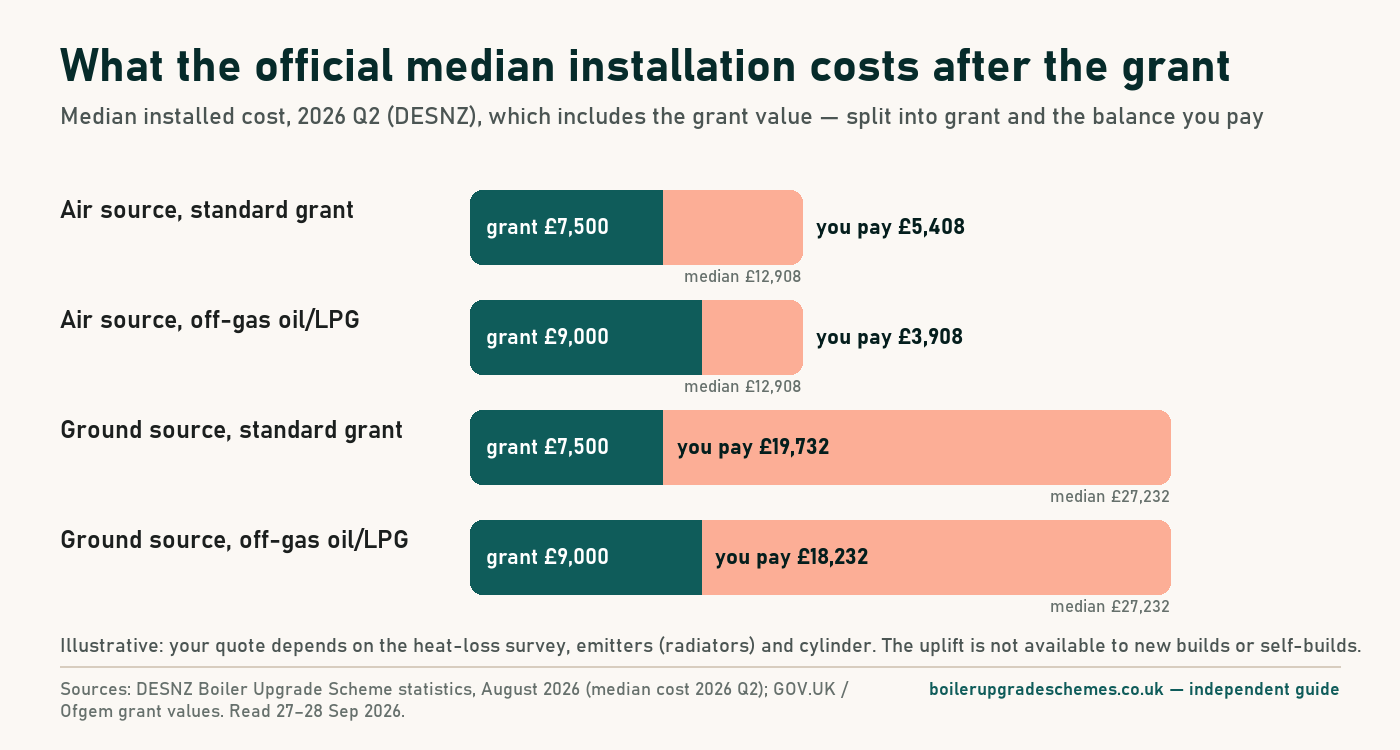
The fairest benchmark is the government’s own. DESNZ publishes the median installed cost of every grant-funded job: £12,908 for an air source heat pump and £27,232 for ground source in 2026 Q2, both including the grant. Take the grant off and the typical air source job leaves £5,408 to pay — or £3,908 for an off-gas oil or LPG home on the higher band. The Energy Saving Trust puts a typical air source installation at around £12,000.
Your own figure depends on the heat-loss survey: how many radiators need upsizing, whether you need a new cylinder, pipework and where the outdoor unit can go. Installing a heat pump in a home also carries 0% VAT until 31 March 2027. Our guides to the air source heat pump cost after the grant and to ground source costs break it down, with a calculator you can run against your own quote.
Three-bed semi, air source heat pump
- Quote at the official median (2026 Q2)
- £12,908
- Grant — on mains gas
- −£7,500
- You pay
- £5,408
- Same house, oil-fired, no gas connection
- −£9,000
- You pay
- £3,908
Not a real installation or a quote. Modelled from the DESNZ median installed cost; the higher band applies to applications made up to 31 March 2027.
Is it worth it — and when it isn’t
At the 1 October to 31 December 2026 price cap, heat from a heat pump running at a seasonal efficiency of 3 costs about 8.8p per kWh. A 90% efficient gas boiler delivers it for about 8.9p, an oil boiler for about 12.4p and direct electric heating for 26.3p. That single comparison tells you who the scheme helps most.
Where the numbers are strong
- Storage heaters or panel heaters. Heat at roughly a third of the cost per kWh. For a home using 12,000 kWh of heat a year that is about £3,158 down to about £1,053 at today’s cap (illustrative).
- Oil or LPG with no gas connection. The biggest grant and a real running-cost gap: about £1,491 a year on oil against £1,053 in the same model.
- An old boiler that needs replacing anyway. The grant makes the upfront cost comparable, so you are choosing the next fifteen years of heating, not paying extra for it.
Where we would slow down
- A young, efficient gas boiler. On a standard electricity tariff running costs are roughly level with gas (£1,053 against £1,063 plus a £108 standing charge in our model). The case is carbon and future-proofing more than savings.
- No room for a cylinder or outdoor unit. Get a survey before you commit to anything.
- A quote well above the official median with no itemised reason. Ask why.
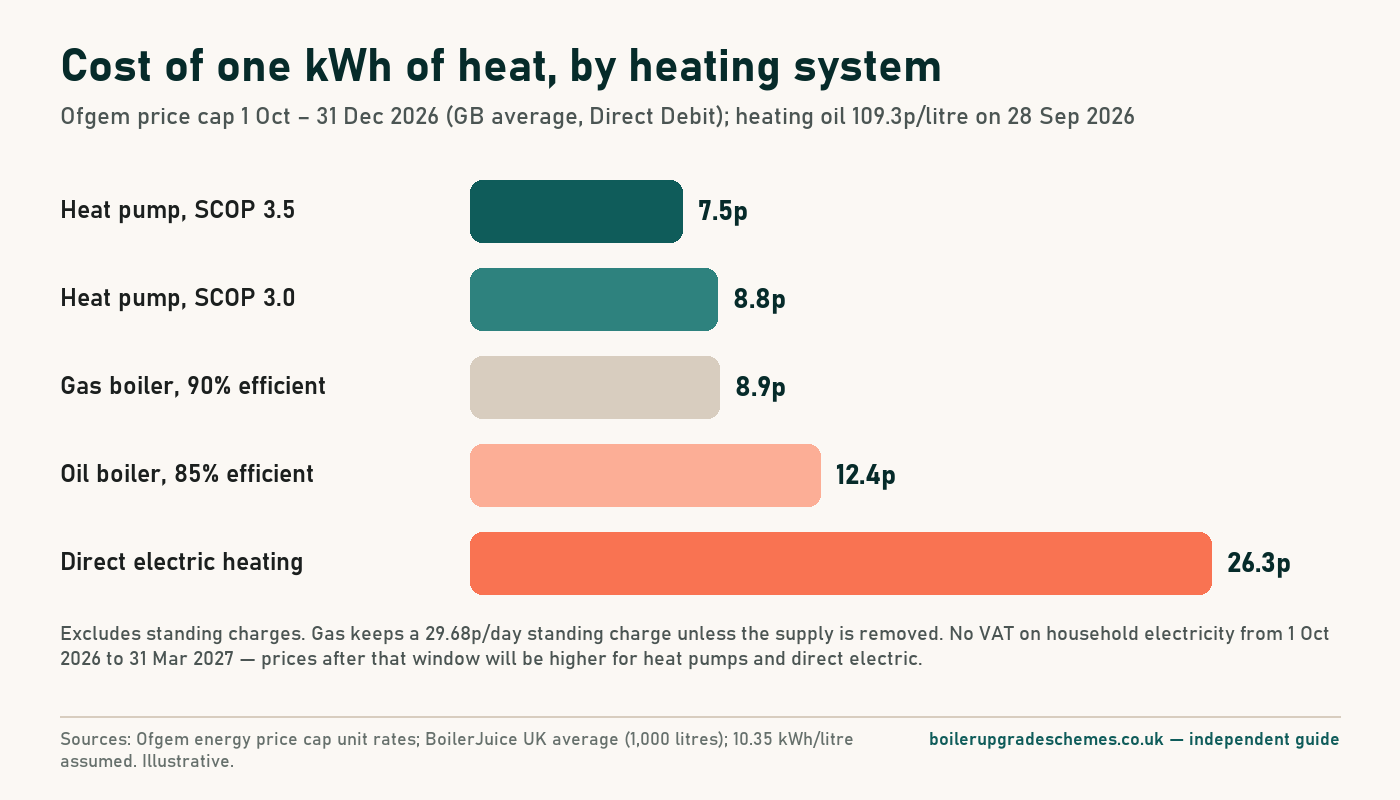
Prices change every quarter, and household electricity carries no VAT from 1 October 2026 to 31 March 2027, which flatters heat pumps during that window. A heat-pump time-of-use tariff can improve the picture further. The full reasoning, including when we think a heat pump is not worth it, is in is a heat pump worth it? and heat pump vs gas boiler.
Check the installer, not the badge
Logos on a website prove nothing. Every one of these checks takes a couple of minutes on a public register, and between them they protect the grant and your money.
- 1
Find them on the MCS register
Search the company on mcscertified.com and note the certification number.
- 2
Check the technology
Certification is per technology. An air source certificate does not cover ground source or air-to-air.
- 3
Look for Boiler Upgrade Scheme status
The MCS search result shows whether the company is registered for the scheme.
- 4
- 5
See the grant on the quote
Deducting it upfront is a legal requirement. If the quote shows the full price, contact Ofgem’s scheme team before paying.
- 6
Compare at least two quotes
Against each other and against the official median. There is no obligation to accept any quote — confirming consent to Ofgem does not bind you to an installer.
What the MCS search shows, field by field · Consumer codes and complaints
Why the dates matter
None of these is a sales deadline. They are published dates, and each one changes what the same installation costs you.
- 31 March 2027The £9,000 off-gas grant (oil and LPG homes with no gas connection) applies to applications properly made up to this date. After it, the same job gets £7,500 unless the government extends it.Ofgem property owner guidance v5.1, 3.12
- 1 April 2027VAT on installing a heat pump in a home moves from 0% to 5%. The rate is set by when the supply happens, so a job finished after 31 March 2027 pays it.HMRC VAT Notice 708/6
- £400 millionThis year’s budget is paid first come, first served. Ofgem put the unallocated balance at £199,563,000 on 9 September 2026, and says the figure moves as vouchers expire or are returned.DESNZ business case; Ofgem monthly update
- 30 December 2029The published closing date for applications. Funding is confirmed year by year inside that window, so the scheme is not about to end — but the terms can change.Find a grant (GOV.UK)
Where the scheme applies
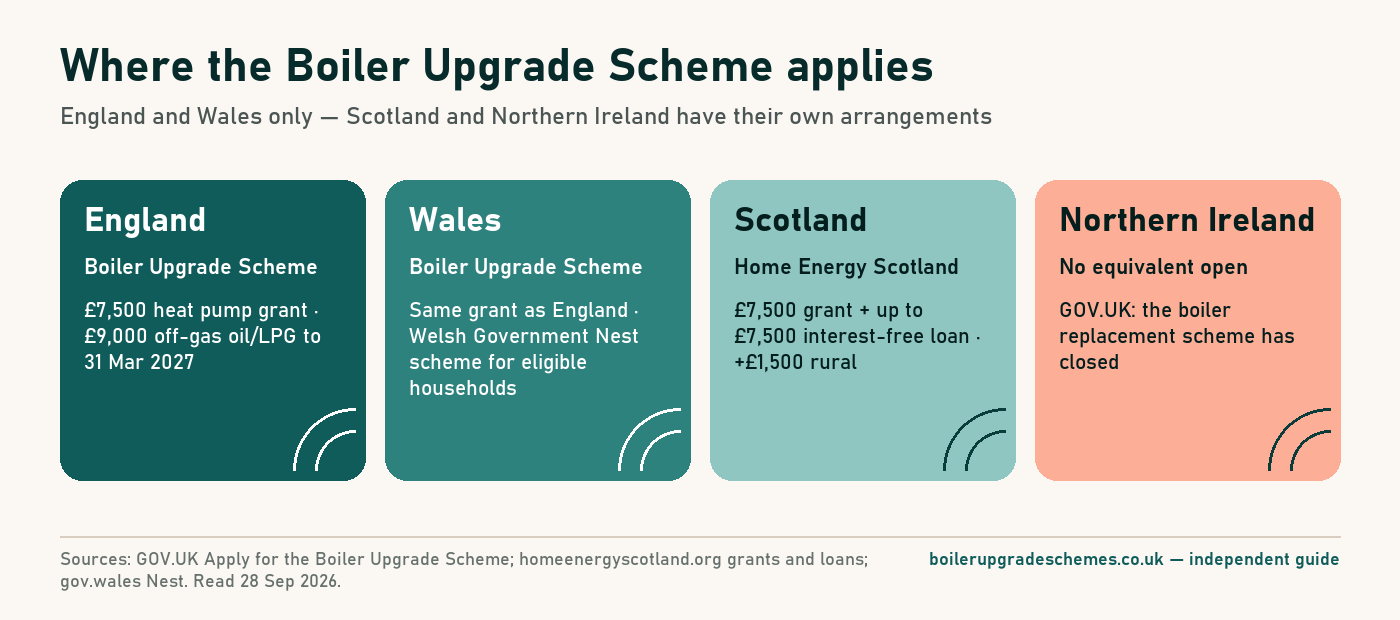
The boiler upgrade grant is a scheme for England and Wales. The other two nations handle heat pump funding differently, which is why the same search can give three different answers.
England and Wales
£7,500 for air source and ground source heat pumps, £9,000 for off-gas oil and LPG homes, £2,500 air-to-air, £5,000 biomass. In Wales, eligible households may also get free improvements through the Welsh Government’s Nest scheme.
Scotland
A separate grant of £7,500 plus an optional interest-free loan of up to £7,500, with £1,500 more for rural and island homes. Hybrids are excluded.
Northern Ireland
GOV.UK says Northern Ireland’s boiler replacement scheme has closed. Check NI Energy Advice for anything newer.
How a heat pump fits into your home
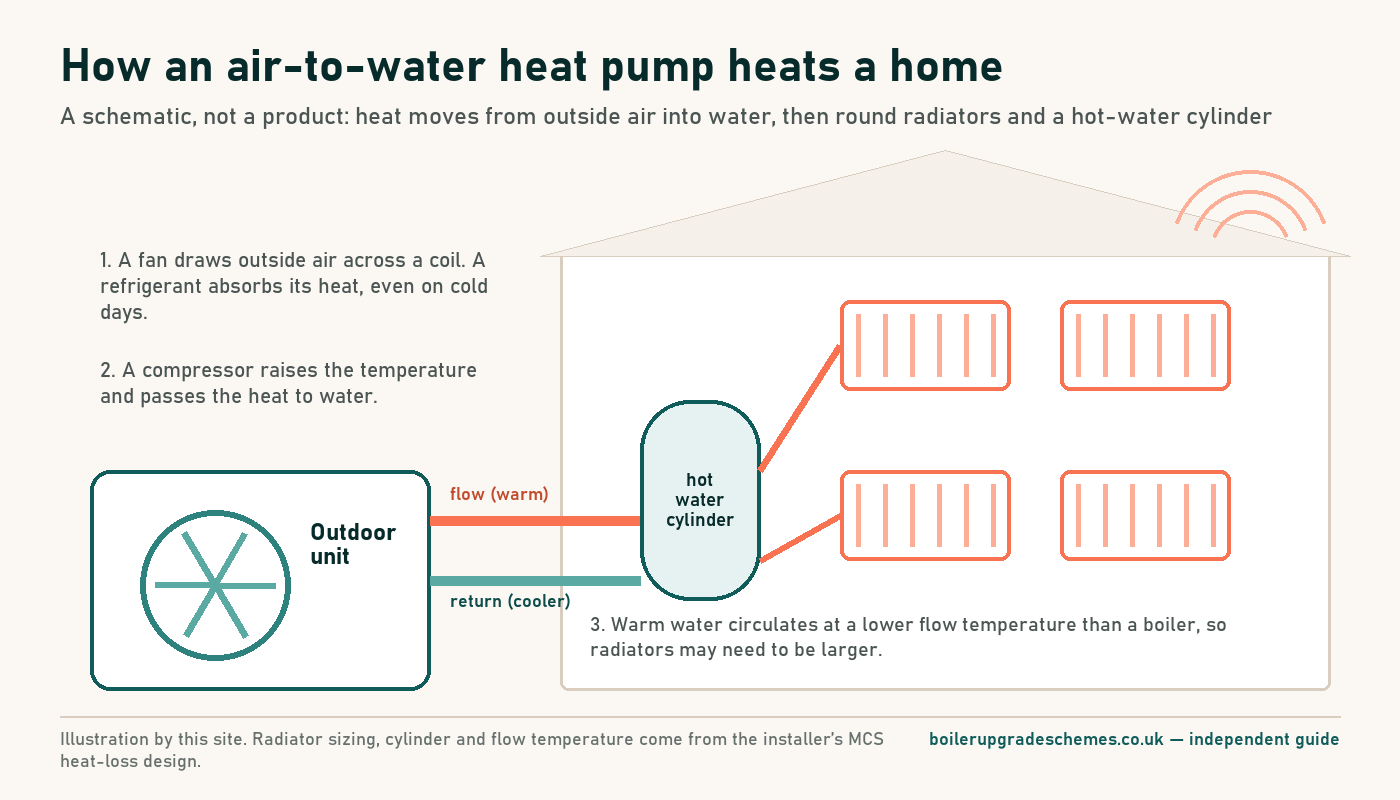
An air-to-water heat pump replaces the boiler, not the radiators. An outdoor unit moves heat from the air into water, which then runs round the same kind of wet central heating system you have now and heats a hot-water cylinder. It works at a lower flow temperature than a boiler, so some radiators may need to be bigger, and the installer must size everything from a room-by-room heat-loss calculation.
A ground source heat pump does the same job with pipes buried in trenches or a borehole — dearer to install, steadier in winter, and mostly chosen by rural off-gas homes: 82% of grant-funded ground source systems went into off-gas properties. An air-to-air unit blows warm air instead of heating water and does not provide hot water, which is why its grant is £2,500.
In England most air source heat pumps on houses are permitted development, within limits on size, position and noise; listed buildings need permission. See planning permission for heat pumps and the glossary for the jargon.
Boiler Upgrade Scheme: the questions people actually ask
Is the Boiler Upgrade Scheme grant £7,500 or £9,000?
Both, depending on the property. The standard grant for an air-to-water or ground source heat pump is £7,500. It is £9,000 if the property has no mains gas connection and the heating being replaced runs on oil or LPG — for applications properly made from 21 July 2026 up to 31 March 2027. An off-gas home on electric heating gets £7,500, and new builds and self-builds are not eligible for the higher amount.
Do I apply, or does the installer?
The installer. The scheme is installer-led: your MCS-certified installer applies on Ofgem's portal, Ofgem emails you to confirm you consented, and you have 14 days to reply. You cannot apply yourself.
Do I ever receive the grant money?
No. Ofgem pays the installer when the voucher is redeemed after commissioning. Since 28 April 2026 the installer must deduct the full grant upfront on your quote and invoice, so you only ever pay the balance.
Do I need an EPC or loft and cavity insulation first?
Not any more. The insulation condition was removed on 8 May 2024, and from 28 April 2026 a valid EPC is no longer required — the installer gives Ofgem the EPC reference if one exists, or other evidence such as a recent fuel bill and photos of the old system. Insulation still matters for running costs, so it is worth discussing.
Can landlords and second-home owners use it?
Yes. GOV.UK says you must own the property, including a business, a second home or a property you rent out. Social housing, including shared ownership, is excluded. Tenants cannot apply, because the grant follows ownership.
Does it pay for a new gas boiler?
No. The scheme only funds heat pumps and, in limited rural cases, biomass boilers. It also does not fund hybrid heat pump systems, and it will not replace a heat pump or biomass boiler you already have.
Does it apply in Scotland or Northern Ireland?
No — England and Wales only. Scotland has the separate Home Energy Scotland Grant and Loan (£7,500 grant plus an optional interest-free loan of up to £7,500). GOV.UK says Northern Ireland's boiler replacement scheme has closed.
When does the Boiler Upgrade Scheme end?
The published closing date for applications is 30 December 2029. Money is set each financial year — £400 million for 2026 to 2027 — and paid first come, first served. The £9,000 off-gas band is due to stop for applications after 31 March 2027.
All twenty questions, answered · What the scheme does not cover · New builds and second homes · Scheme statistics · End date and budget
What stops people — and what the evidence says
Four objections we hear constantly, each answered with a number and a source, and each with the part of the objection that is fair.
“A heat pump will not heat my old house.”
The government-funded Electrification of Heat trial put 742 heat pumps into a broad spread of housing types and concluded that there is no property type or architectural era that is unsuitable for a heat pump (Energy Systems Catapult, December 2021). What matters is the design: an MCS installer must size the system from a room-by-room heat-loss calculation, which may mean larger radiators. More on the myths.
Fair point where it applies: a poorly designed system with undersized radiators will struggle, which is why the survey matters more than the brand.
“It will cost more to run than gas.”
On a standard tariff it is roughly level. At the 1 October to 31 December 2026 cap a heat pump with a seasonal efficiency of 3 delivers heat at about 8.8p per kWh against 8.9p for a 90% gas boiler — and you stop paying the gas standing charge if the supply is removed. See the running-cost maths.
The Energy Saving Trust's own wording is that on standard tariffs heat pumps "can cost slightly more to run than new gas or oil boilers". A heat-pump time-of-use tariff is what usually tips it.
“The grant will run out before I get round to it.”
This year's budget is £400 million, and Ofgem reported £199,563,000 still unallocated on 9 September 2026. The scheme's published closing date is 30 December 2029. The date that really moves money is 31 March 2027, when the off-gas £9,000 band is due to end.
Budgets are first come, first served, so a year can be allocated early — but nothing suggests the scheme closes this year.
“Installers inflate the price to swallow the grant.”
You can test that. The official median installed cost of an air source heat pump was £12,908 in 2026 Q2, 11% lower in real terms than in 2023 Q2. Get at least two itemised quotes, compare them with that figure, and check each installer on the MCS register. How to check an installer.
Ready for quotes? Ask heat pump installers
Only an MCS-certified installer can apply for the grant, so quotes are the next step. Tell us about the property and we pass your enquiry to independent heat pump installers covering your postcode — they contact you, check your eligibility and show the grant on the quote. Check each one on the MCS register before you sign. No charge, no obligation, and no phone call unless you ask for one.
What happens next
- We read your enquiry and check which kind of firm can help.
- We pass it to relevant independent firms that cover your postcode.
- They contact you with questions or a quote. You compare, and decide — with no obligation to go ahead.